
Growing old gracefully on the John Muir Trail
After a certain age, concessions must be made. A 10,000-foot summit is best taken in stages, not all at once. Pack weight matters. Ibuprofen is a trail essential. Choices must be made: camp chair or bourbon?
- July 14-19, 2025
- 26 miles on the John Muir Trail in the Sierra National Forest, from the Florence Lake ferry to the Vermillion Valley Resort ferry.
By Mark A. Neikirk
There came a place on the John Muir Trail where, after countless switchbacks designed to abate a generous elevation gain, a bald slab of granite invited respite.
Here, in what could easily be mistaken for the Bear Ridge Trail’s high point, sparse vegetation allowed for an uninterrupted panorama of the mountains and valley surrounding this high place. The trail up had passed through a thick forest, the view confined to the immediate surroundings. Every 50 yards or so, the trail had changed directions as it zig-zagged upward, each switchback a little more inclined than the last. There was a monotony to this, and with temperatures in the 90s, it was not a pleasant monotony. Just a mindless slog up a mountain purgatory.
Bob Pauly and I, who, on this particular day and at this particular point on the trail, were ahead of our five companions, came to this break in the forest and thought maybe we had reached the trail’s summit. But we also were aware of an immutable rule that governs mountain hiking: There are more false summits than actual summits. Very often, when you think you are at the top, you are not.
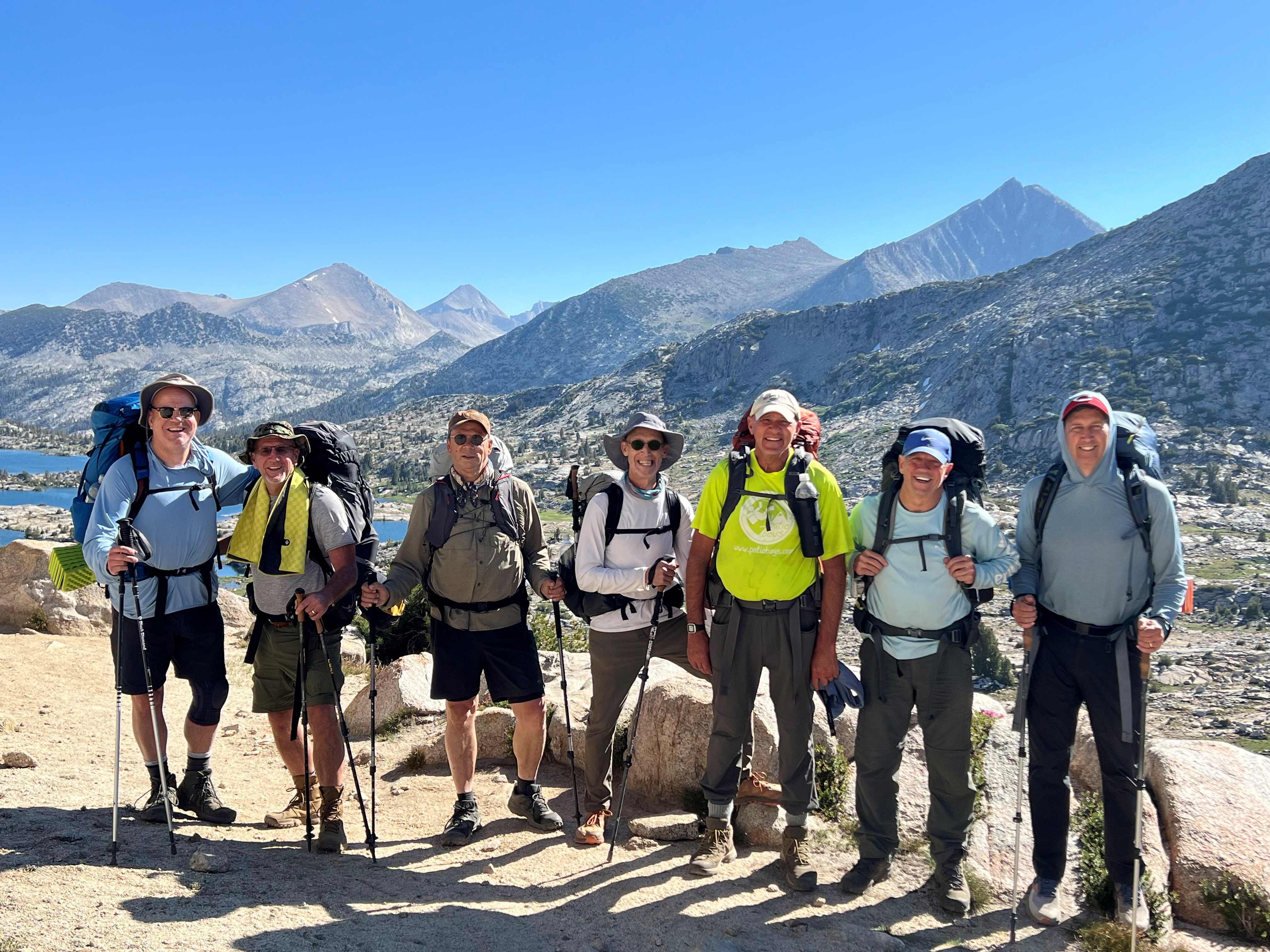
Soon enough, the others in our group arrived. Mike Hammons. Mark Shields. Rick Rafferty. Jon Stratton. Mark Goetz. Bob and I already had our packs off and our water bottles out. I was one fading thought shy of a catnap.
“Good decision, stopping here,” Goetz commented, his knowledge that this was not the top obviated by the pronouncement. Goetz, who planned this trip, carries two trail maps, one on paper and the other on an iPhone app. Generally, he knows at all times precisely where we are. We had climbed 600 feet of an 800-foot climb that would end at 9,880 feet, just below the Sierra Nevada Mountain’s treeline at 10,000 feet.
With our position subordinate to the summit confirmed, we fully embraced the pause. If we felt the least bit guilty for stopping too soon, it helped that we were taking our rest in a glorious place. Much of our hiking had been under a cloudless sky as blue as the eyes of a newborn baby. But here, pillowy clouds floated over us as if tugged along by invisible stage wires being manipulated in slow motion. The high mountain air was cooler, and a light breeze — the same breeze pulling those clouds — was a luxury, as was lying on the granite, the warm rock therapeutic on tight, sore backs. The mosquitos, ever present at lower elevations, were sparse here.
Other hikers poured past us, usually walking alone or with a mate. Our group of seven would be the largest of any others we encountered over the course of our five days, four nights on the Muir Trail. We also were the oldest hikers on the trail. With age comes concessions. Resting short of summits is one of those.
A young woman walked by. She was a through-hiker, meaning she was hiking the whole trail, 214 miles from end to end, and she moved well despite the presence of bright pink athletic tape wrapped around one of her knees. Goetz, himself hiking with an elastic knee brace, told her he had another if she would like to have it. No, she replied, she thought she would be fine until she got to her stop for the night, the Vermillion Valley Resort, which was four miles away with two of those miles downhill, as the trail dropped 2,000 feet. Downhill is hard on knees. As she parted, she said she just hoped “it didn’t pop out again,” meaning her kneecap. Ah, youth!
Now there is something we don’t have. Youth.
□ □ □
Three of us are over 70 and the others over 60. None of us, that I know of, has any metal joints. No mechanical knees or hips or shoulders. But I know that one us has a pacemaker, one of us has a degenerative disease, two of us are cancer survivors, one us is only a few months beyond a life-threatening blood clot, and then there is that previously mentioned braced knee, several backs easily susceptible to strain, and Lord knows what else. Add to this the fact that one of our original troupe was sidelined at home with torn ankle muscles and you’ll understand why we embrace the adage coined by Bette Davis, “Growing old is not for sissies.”
But growing old is not for giving up either, and our little group of men who haven’t given up on hiking also embrace an adage of more recent vintage — its vintage coinciding with our own youth. I’m referring to counterculture cartoonist Robert Crumbs’ Mr. Natural and his wise words: “Keep on truckin’.” Yes, like the Grateful Dead’s Do-Dah Man.
We are mindful of the grace we’ve received in still being able to do this. That is, to put 20 pounds or twice that on our backs and walk a trail mainly populated by people younger than our children. One night around our camp circle — we mostly avoided campfires because the woods were so dry — the conversation turned to what we value most. Faith, family, and friends were atop the lists. The next morning, as if to underscore what it means to live those values, Jon Stratton, a preacher’s son, led us in prayer before we started the day’s hike, giving thanks that we could do this, and knowing that not everyone can. I would return home to the obituary of someone from my work life and an email updating me on the pancreatic cancer of a good friend. Her news was good, but only in the context of having pancreatic cancer. A recent PET scan promised more time.
What comes to mind to me are the lyrics of a Jesse Winchester song, “All That We Have is Now,” recorded for his last album, when he 69 and knew he was dying from his cancer’s return. It returned, as cancer likes to do, angrier, meaner, and more determined than its first visit.
The sun is going down
There's shadows all around…
We must do this again sometime
But I can't tell you when
But what a joy it's been
All that we have is now.
□ □ □
Having turned 70 in March, I have found myself reflecting on the significance of being this old. When she turned 70, my mother was diagnosed with multiple myeloma, a disease that would take its time but eventually take her life. A few years earlier, my father was gone 14 months shy of his 70th birthday.
My father was debilitated by throat cancer for seven years before his death. He could not eat except through a stomach tube nor drink except by sipping on moisture that melted inside a frozen bottle of water that he carried everywhere. A full drink of water would go into his lungs instead of his stomach, and that would put him in the hospital again, usually for a week or so. He responded by going to his retirement job every day that he was able. That was at the Keeneland, the thoroughbred racetrack in our hometown, Lexington, Kentucky. During meets, he was in the back room counting the gate and hanging with friends who, like him, loved being at the track where princes and paupers stand together in the betting line, equally certain they have the future figured out. Between meets, Dad worked the horse sales, recording the million-dollar bids on yearlings. Princes bid, paupers watched.
If I were in town and at my parents’ home around lunchtime, I could expect to see Dad come in, lay down on the bed, and my mother rig his stomach tube to feed him a bottle of Ensure, after which he drove back to Keeneland. He just kept doing what he loved. Like the Do-Dah Man.
On the night when he went to the hospital for the last time, Dad left the ingredients for chocolate fudge on the counter, ready for him to concoct for those of us who could eat it, though he could not. He was a world class maker of fudge. I cannot remember him making anything else unless it was a cup of coffee. Even when he could eat it, he never made fudge for himself. It was for family. For friends. And on that night, his prep of the ingredients was an act of faith: There would be another day to make fudge. And friends and family to eat it.
As for my mother’s illness, it was protracted and, like Dad’s, would involve repeated hospitalizations, in her case off and on for 16 years. On countless days and nights, I and my siblings sat at her bedside, holding her hand until she awakened, each time with a smile and once with a question, “Why am I here?” She meant at the hospital but the question seemed metaphysical, as if she was asking why she was still on Earth. The answer was to teach us. To love us.
She knew death. She was certain she had died one night, seeing a great light and being told, “Not yet.” She would live long enough to see and hold my grandson, her great-grandson, Marshall, who was named for her husband, for my father, by my daughter.
I don’t mean to suggest that hiking is reason enough to be given the gift of a longer life, only that if given that gift then we are obliged to live fully ─ to enjoy the gift and to do so at every chance in the company of family and friends, giving and receiving love. The word “give” or one of its derivatives in that sentence repeatedly. Not a coincidence.
□ □ □
I am trying to consider how hiking is different at age 70 than it was at say, age 20. But with 50 years between the two, I’m not sure I can remember enough about my early days hiking to draw much of a comparison.
Packing is certainly different. The pharmaceuticals packed by our twenty-something selves did not include, as they did for this trip, things like Lisinopril, Atorvastatin, Levothyroxine, Metformin, Eliquis, Complete Men 50+ Multivitamin/Multimineral Supplement, 81 mg baby aspirin, 1200 mg burp-less soft gel fish oil, and hemorrhoid cream.
Nor, at 20, did I have to make a decision like this: Should I take a small Nalgene bottle of Willett Family Estate bourbon, a Helinox Zero camp chair or both. Each would weigh about a pound, the bourbon a little less and the char a little more.
I opted for the Helinox, having been so advised by Mark Shields who said, “You’re going to want that.” I failed to tell him that if I took the chair, I was leaving the bourbon, as I wanted my pack to weigh as close to 20 pounds as possible. I didn’t quite make that. I was at 23 point something. Mike Hammons, who at 72 was the oldest among us, got his to just under 20. I’m still not sure how. Magic.
In my twenties, I was mindful of weight but never obsessive about it. For this trip, I bought small luggage scale and packed and repacked until I have my load to as light as I thought I could get it and still live comfortably on the trail. Less weight, particularly on climbs, matters at any age but especially now. To state the obvious, it is physically different to hike now than it was at 20. It’s harder.
I have no recollection of worrying about climbing up a mountain when I was 20. We just went. I was over 50 before I heard someone lament, “That’s a thousand-foot elevation gain.” If someone did say it, it went right by me. And then one day it did not. A thousand feet became some kind of metric for difficulty. When Mark Goetz first proposed hiking this section of the John Muir Trail, one of the first things I looked at were the elevation gains, telling myself – admittedly, without looking too closely – they were not too bad.
One reason they did not look too bad is that the National Geographic map for the John Muir Trail, our bible, compresses all 214 miles of the trail into one 16-page booklet. Waypoints are labeled in 7-point type. They can be a little difficult to decipher, even with 2X readers. A mile of trail is squeezed into a half-inch of topographic depiction. One must look very closely to realize what probably should be obvious: A lot can happen in half an inch. And a lot did. Plus or minus, our gross elevation gain was 1,000 fee each day, often in steep bursts over mountainsides exposed to a baking sun. Frankly, it was better not to realize the difficulty before buying a plane ticket to California.
Our day began in early afternoon’s heat. The trail went uphill immediately. Toward the end of the day, as we looked for a campsite, the map seemed to suggest there was one with water not too far ahead. But when Jon Stratton walked ahead to scout a campsite that, according to the map, had water he found the little stream there dry. A couple came down the mountain and told us water was at least three miles away with much of that distance involving difficult climb. They said they wouldn’t advise attempting it without at least three liters of water each, which would weigh six-plus pounds. They also looked at us with pity or scorn, I’m not sure which, as if to say, “The chances of you old guys making it with or without water are slim and none.” Arrogant bastards.
We did make it up, although it would be the next day and involve getting started before the sun rose above the mountain. Once we reached a part of the trail with more shade, we took a break. As we rested in various states of sprawl, a lanky young woman came around the bend, proceeding effortlessly uphill as if she were the cyclist Tadej Pogačar in the Alps. She was all grace and speed, and she had one of those 100-watt smiles. “Well, well. Look at this gaggle of girls,” she observed as she whisked past us. There was no condemnation in her comment. Just good humor. I’m sure we were a sight.
Soon enough we would be at the Sallie Keyes Lakes, side-by-side alpine lakes at 10,194 feet, putting them just 700 feet below Selden Pass, which would be our high point for the hike. Approaching the lakes, the trail flattened out and followed the western shore of the first lake for about a quarter mile, then crossed a narrow connector stream to the second lake before heading uphill to the pass. We found a campsite near the shore of the second lake at the base of what would be the next day’s climb.
This was an especially welcome campsite for me, as I saw trout in the lake as we walked here, and I intended to fish. Every couple of hundred yards when the trail followed the first lake, I walked down to the water’s edge and every time there were trout holding in the shallow water. On the way in, I’d been informed that I might catch a California golden trout, a species I’ve never seen much less landed. This would be the place.
With a fly rod and No. 18 caddis, I went to work and by day’s end had landed 12 fish. This little fish, tiny like Smoky Mountain brookies, takes a fly with ferocious zest. One, all of 7 inches long, leapt three feet into the air, making every effort to spit the fly but the hook held.
These fish are maybe the most beautiful of all trout, which is saying something given how gorgeous a brook trout or a cutthroat is. I thought a golden would look like a trout version of goldfish. It does not. Its base color is green or, more precisely, shades of green, with a striking lateral band of luminous orange from gill to just short of the tail. The top of the body is speckled with back dots, some of which continue onto the dorsal fin. The belly is a light green. Every fish, of course, is not colored exactly the same, but generally there is a golden luminescence beneath all of the other colors, almost as if the whole fish is lit up from the inside, like a firefly’s tail.
□ □ □
It wasn’t just that I was catching these rare trout, but also where I was catching them that made the experience so rich. Until this spot, our hike had passed through terrain typical of the High Sierras. Ship mast pines. Taller mountains, often distant and just as often obscured by the tall pines. It was pretty, in the way that the mountains and forests of the western United States are pretty. But it was not spectacular. No grand vistas. No postcard views. There were the trees behind you, the trees beside you, and the trees ahead of you. Bob Pauly described, for example, our Day One like this: “Difficult hike without much scenery.”
Sallie Keyes and, the next morning, the trail up to Selden Pass altered the landscape. Literally.
The trail up the pass provided an open, unobstructed view of the Sallie Keyes Lakes, both of them reflecting perfectly the expansive mountain range around them. And once at the top, the view due north was of Marie Lake, which is divided into thirds so as to look like three lakes, one about twice the size of the other two. Jon Stratton would later capture the magic of this view in these words:
“One memory that stands out to me is the fact that I did not see a lot of spectacular scenery until we got to Sallie Keys Lakes. As we were heading up to Selden pass, I found myself continually looking backwards to see the lakes and the creek cascading over the rocks down toward the lake and thinking what a beautiful site.
“Surprisingly, when we reached the top of the pass and looked in front of us, I was almost overcome by the beauty of what was in front of me; so much so that I almost forgot where I had just been. Coming over that pass was the most spectacular and memorable moment for me on the trip.”
The part he forgot was the difficulty of being here. Beauty does that. It erases difficulty.
□ □ □
Atop Selden Pass, on our third day out, we met a man named Jeff Butler from San Francisco who was through hiking the John Muir Trail, which typically takes three weeks, to commemorate his impending 70th birthday. Silver-haired and ruddy from his time on the trail, he was happy to see us, men of a certain age. His age. All those gazelle Millennials, Gen X’ & Z’ers were too rushed to pause. By their speed and ease, they reminded we Baby Boomers, who once thought the world revolved around us, that it does not.
We all chatted for a time – trail small talk that amounted to a celebration of our being able to be out here, still doing this. There were no great insights as to what it means that we are. It was as best an existential moment. It just was. It existed. Period. The end. The end? Not quite. Not yet. We’ll keep on truckin’. The Do-Dah Men.
□ □ □
We headed down the pass, rested and ate lunch at Marie Lake, refilling water bottles and taking naps. I have iPhone snapshots of everyone in repose, some seeking shade, some sunning as if at Daytona Beach. Everyone looks happy, rested.
We hiked from there to a sweet little wooden bridge over Bear Creek, which tumbled at that point over and between boulders, creating loud, dramatic rapids. A campsite a few hundred years away had abundant room for our seven tents, and we set up for the night. The week’s first cloud cover had moved in. As a precaution, some of us put our rainflies on our tents for the first time on this trip. Before, we left them off so we could wake up and count stars until we dozed off again. The stars were bright against the black sky and countless. The Milky Way was a soup of stars. Though blended into oblivion when city lights erase the night, in a wilderness it flows like a celestial river, milky like its name.
Here is one difference in being 70. I first camped in the backyard in a pup tent with my body outside the tent, lying on my back, staring up at the sky. Contemplating infinity and eternity. Later, as a young man I stayed up late, propping my head on a rolled up sweatshirt and stared at the sky, contemplating infinity and eternity.
Now, I watch the forecast and, if there’s little chance of rain, I leave the fly off my tent so I can stare and the sky and contemplate infinity and eternity. Those subjects hit a little closer to home than they once did, but they are not so disturbing as to keep me from falling back asleep. I do so, however, knowing that I’m likely to wake up again in an hour because, at 70, I no longer sleep through the night. An arm will fall asleep because a nerve is pressed. A dream may startle me. Or my bladder call for immediate attention. I am destined awake and then doze many times over.
Each time. Those stars. Infinity. Eternity. Always there, as they have been since the first night I slept under them. All those years ago. Perhaps next year, too.
Here is a summary of our trip by day, provided by Bob Pauly:
Day 1 (July 14): 5- mile hike from Florence Lake to near John Muir Ranch. Difficult hike without much scenery. Highlight of hike was eating at the ranch and being able to fill water bottles out of a faucet. Camp site was in a random place with no water. Mooch rating: 2.*
Day 2 (July 15): 6-mile hike that took 6 hours up to Sallie Keys Lakes. Difficult hike with no water until the lakes. beautiful lakes. Started hike at 6 a.m. Mooch rating: sub 4 (campsite would have been 4 but we couldn’t have a fire since we were above 10,000 feet).
Day 3 (July 16): 7-mile hike over Seldon pass. Best hike of trip. Pass had a beautiful view of Marie lakes. “Standing by peaceful waters…” (a reference to a John Prine song, “Lake Marie; John Prine is one of Bob’s favorite singer-songwriters). Early in the hike, I was suffering from what I think was altitude sickness. Had to go a few extra miles because the proposed camp site was closed. Random campsite. Mooch campsite rating: 3 (no fire because we thought it was too dry and thus risky).
Day 4 (July 17): 1-mile hike to catch ferry to take us across Edison Lake to Vermillion Valley Ranch, a resupply camp along the trail. “VVR” had a general store, cold beer, a diner $10 showers, WiFi, and a free camping area for hikers and their tents. Had a great burger and fries with a free beer for lunch (VVR gives all hikers one free beer). Got to talk to a lot of interesting people that day. Mostly through hikers (both John Muir Trail through hikers and Pacific Crest Trail, or PCT, through hikers; the two trails are together through this stretch of the Sierra Nevada mountains; at 2,653 miles, the PCT is more than 10 times the length of the Muir trail). Campfire at night with Paint Your Wagon (trail name of one of the VVR hosts; “Paint for short,” he told everyone). He offered up some Indiana and Tennessee whisky. No Mooch rating.
Day 5 (July 18): We got up, packed and caught a van to shuttle us back to Fresno, California, where we spent the night in a hotel and flew up the next day.
*Mooch is Bob Pauly’s trail name. Over his years of backpacking and leading the Patio Boys (“A drinking club with a hiking problem”), he has developed a 5-point scale for ranking campsites, which involves such factors as being flat, have easy access to water, and accommodating of a campfire. Not that he is demanding, but no campsite in about 30 years ratings has ever received a 5.
Comments on this essay: Email